In August 1969, half a million kids drove to a dairy farm in upstate New York and invented youth culture. Within the decade, the youngest of them turn 80.
Now watch one of them — the man who saw Hendrix play at dawn — walk into a medical supply store. He's handed a beige plastic scooter with a model number for a name. And he says no. Not because he doesn't need it. Because riding it means announcing he's finished.
So he stays home. The block gets shorter. The invitations stop. The pride that built his whole life starts to shrink it.
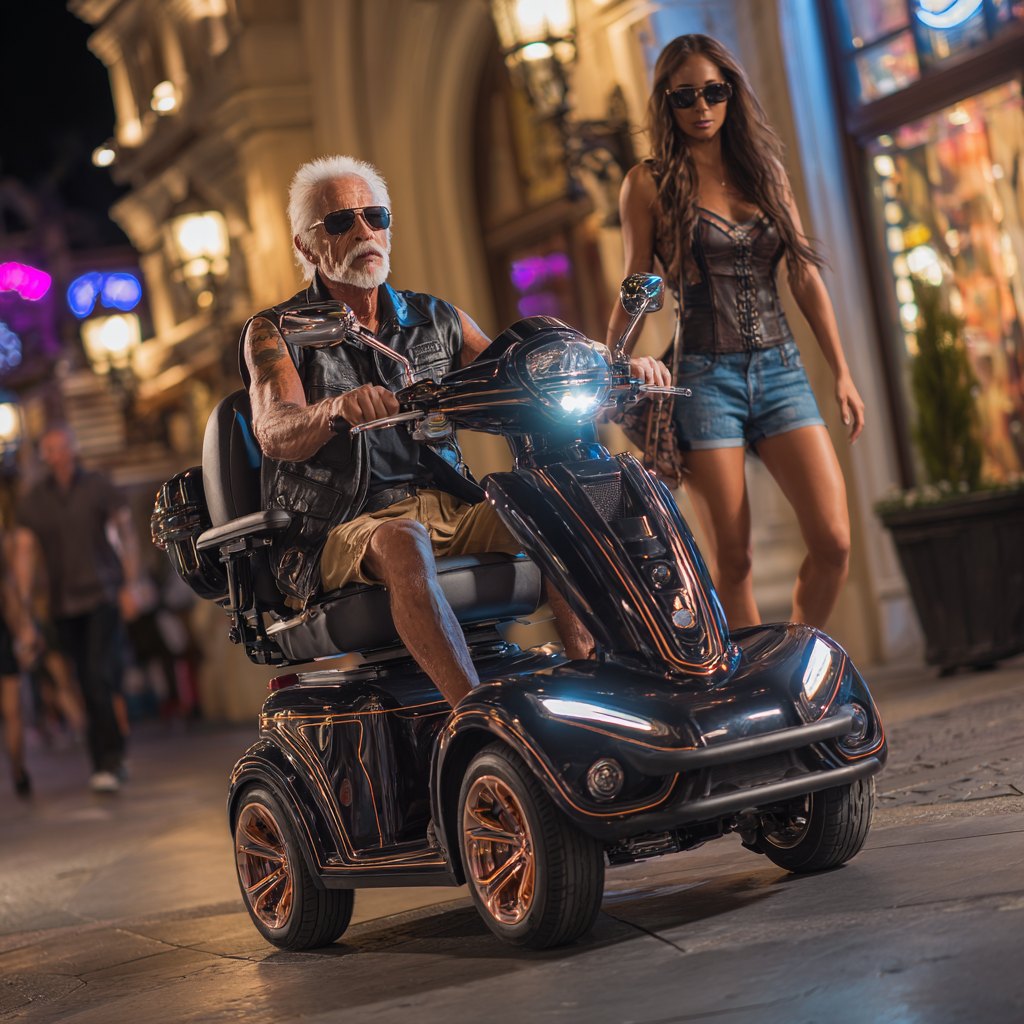
Nobody has built the machine that lets him stay himself. Matte black and chrome. A leather saddle. Copper in the wheels. A scooter an old rock star would be proud to ride — sold as a vehicle, never as an aid.
This page is a researched starting point for that company: the market it enters, the person it serves, the numbers it could run on, and a 90-day path to test it for less than $10K. Researched, priced, and free — take it and build it.
Concept visuals are AI-generated — this machine doesn't exist yet. That's the invitation.
$2.5BGlobal market¹
~6%/yrMarket growth¹
$4,995Unit price est.
~50%Gross margin est.
<$10KCost to validate
×110The model: water, 5 yrs²
Concept 01 — the night ride
01 — The Thesis
Every mobility scooter on the market is designed to satisfy an insurance form. Beige or burgundy, plastic body, a product name that sounds like a printer. The whole category speaks to its customer as a patient — and its customer is done being spoken to that way.
The fix isn't a mystery. The same move keeps working, industry after industry:
Liquid Death · Water
$3M → $333M
Five years, ×110. The same water as everyone else — sold with a soul. Their first ad cost $1,500 and ran before the product existed.²
Warby Parker · Eyewear
$771M/yr
Glasses were a prosthetic — until frames became fashion. The category playbook this page runs, at 2024 revenue.⁵
Apple · Hearing aids
FDA-cleared, 2024
A clinical-grade hearing aid, hidden inside AirPods Pro. Stigma deleted by design.⁵
byACRE · Rollators
$699 vs ~$100
A Danish design house wins Red Dot and iF awards for walkers — the identity premium is already alive inside aging equipment.⁵
Mobility scooters are still waiting for theirs. And the customers arrive by demographic clockwork, every day, for the next twenty years.
02 — The Market
This is not a niche. It's a global market compounding on the oldest force there is: people getting older.
Mobility scooters, global market
Analyst estimates, $B¹
The US alone: ~$0.7B in 2026. North America is ~44% of the world market.¹
The real price ladder, checked August 2026:³
The default: Drive Scout ~$800 · Pride Go-Go ~$1,300. Airport beige, folds into a trunk, forgotten by design.
The middle: Golden Buzzaround $1.9–2.6K · Pride Victory $2.5–3.2K. More range, same message.
The proof of premium: Pride's Baja Wrangler 2 sells for $5,538. Afikim's Afiscooter S4 for $6,479. People already pay $5K+ when a scooter feels like a vehicle — but both sell capability. Neither sells identity.
In vehicles, identity is where the margin lives — a Harley, a Jeep, a Vespa is engineering plus a story. The mobility scooter is the one vehicle still sold without one.
03 — The Buyer
Two buyers, one purchase.
The rider was 25 in 1975. His enemy isn't another scooter — it's refusal. People who need a scooter won't ride one, because the scooter announces decline. So the world shrinks: skipped outings, cancelled trips, a smaller and smaller radius. The category's biggest competitor is the customer's own pride. That's not a hunch anymore — it's measured:
51.3%
of new mobility-device use among older adults in the US ends within one year — and the research names stigma and esthetics among the leading reasons people quit or refuse.⁶
The payer is often the adult child, in their fifties, shopping after a fall or a near-miss. Guilt plus love. They dread handing a parent the object that says "you're old now." A machine with presence flips the whole transaction: refusal becomes desire, and the purchase turns from an apology into a gift.
The moment: the family conference after the fall. The doctor's nudge. The quietly shrinking life.
The money: a premium cash purchase, deliberately outside Medicare — insurance covers the beige ones, which is exactly why every incumbent designs for paperwork instead of for the person.
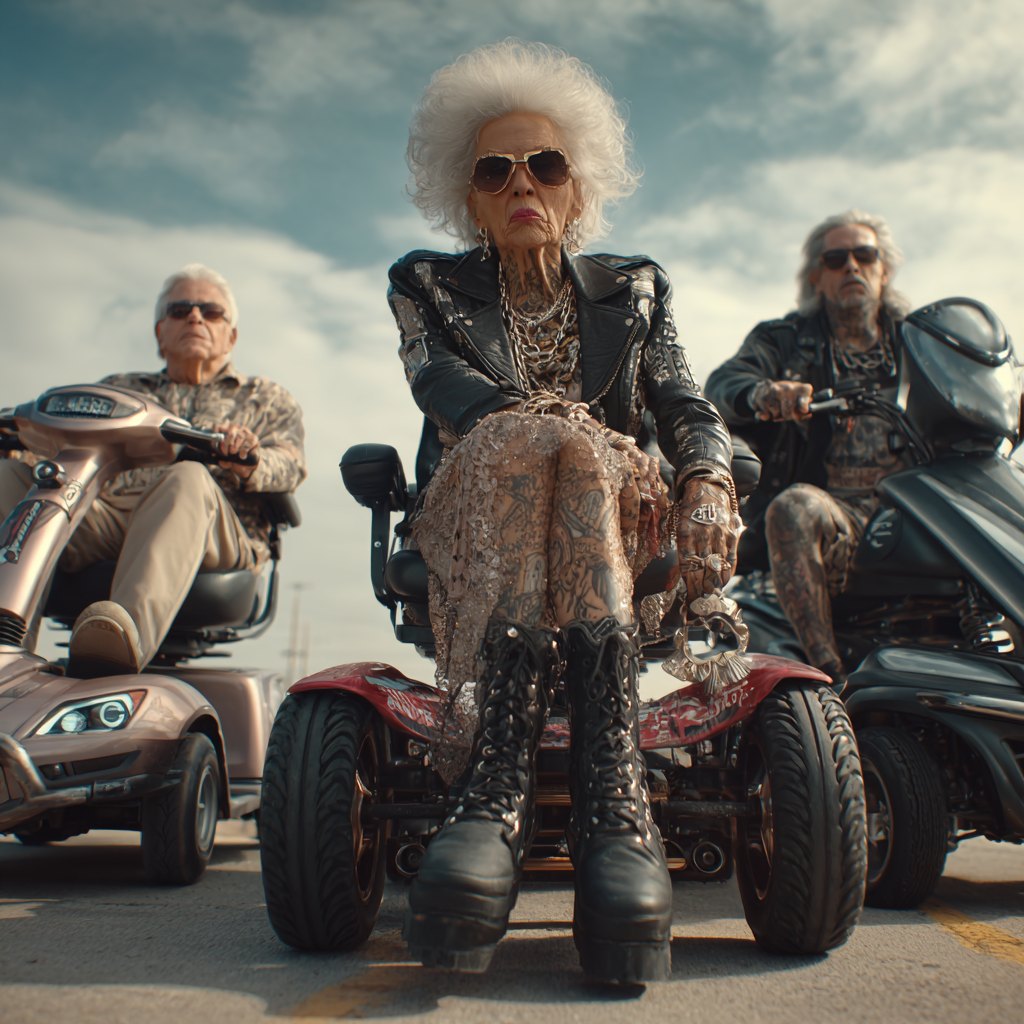
Concept 02 — the crew
04 — The Product
Phase one is not a vehicle company. It's a customization program on a proven donor platform — which is why one person can start it.
The build: wheels, handlebars, seat, body panels, paint, sound — matte black, chrome, leather, copper — on a scooter that already passed every test.
The price: $4,995, white-glove delivery included.
The rules: no vehicle engineering, no medical claims. The donor's spec sheet stays the spec sheet.
The merch ships day one: patches, tour tees for the grandkids. Nothing spreads this faster than a grandkid wearing grandpa's scooter shirt.
Phase two, if the pull is real: an own model with an established manufacturer.
05 — The Wedge
The entire category competes on medical legitimacy, specs, and price. Zero players compete on identity. That's the whole wedge, and it's wide open.
A newcomer doesn't need better engineering to win here. He needs a better mirror — a machine that shows the rider who they still are, instead of what happened to their body. The incumbents can't follow without contradicting their own insurance-driven existence; a medical-equipment conglomerate attempting rock and roll has the energy of a committee writing a meme.
Everyone else sells what happened to your body. This machine sells who you still are.BRAND THIS / 001
06 — The Competition
The incumbents — Pride (Go-Go, Victory), Golden (Buzzaround), Drive Medical (Scout). Insurance-driven, dealer-networked, $800–$3,200. They compete on coverage codes and price, and they're good at it.
The gadgets — EWheels (EW-36 ~$1.7K, EW-72 ~$3.5K). Speed specs with flame decals. Spec-sporty, not identity. Sold as gadgets, reviewed like gadgets.
The capability premium — Pride Baja Wrangler 2 ($5,538), Afikim S4 ($6,479). They prove the price point exists. Then they speak medical anyway.
The open position — badass, $5K, sold as a vehicle. Nobody is standing there.
Where everyone stands
Every major US mobility scooter line, by street price³
The premium rows already exist — Baja Wrangler 2 sells $5,538 of ruggedness, Afikim $6,479 of touring comfort. The top-right corner — premium, sold as identity — is still empty.
07 — The Business
Here's the fun part. One unit, phase one: figures est.
Where the $4,995 goes
One unit, phase-one build est.
A proven donor scooter, transformed. No factory, no tooling, no certification battle.
Customer acquisition is one film, not an ad budget. The receipt: Liquid Death's first commercial cost $1,500, ran before the product existed, and pulled three million views — retail came to them.² The category contrast here is just as violent. No paid spend until organic proves.
The scenario, narrated — a scenario, not a forecast, but every number is checkable:
Year 1: 200 units through one workshop and a white-glove partner ≈ $1M revenue, ~$470K gross. Two people and a paint booth.
Year 3: 1,000 units plus merch at 70%+ margins ≈ a $5M+ company.
Validation: one hero build + one great film + a waitlist page = $5–8K all-in.
The kill gate: 50 paid deposits in 60 days — or stop. Total downside: under $10K.
08 — The Risks
Stigma may run deeper than styling. Some riders will refuse any scooter, however it looks. The deposit gate exists to test exactly this, for under $10K.
Liability and compliance. A modified mobility device must stay inside the donor platform's ratings, make zero medical claims, and carry product-liability coverage from day one.
Platform dependence. Until phase two, donor supply and build quality sit with manufacturers who owe you nothing.
No patent moat. Anyone can copy the move. Speed, community, and story are the only defense — which is how every identity company on earth lives.
The niche ceiling. Rock and roll could cap at a sub-segment. The eyewear precedent argues identity expands categories rather than slicing them — but that's the bet.
09 — The Prize
If the identity premium proves out, this was never a scooter company. It's an identity house in aging equipment — and every object in the "you're old now" aisle is waiting for the same move. Rollators already have their design house: byACRE charges $699 for the world's lightest walker and wins design awards for it.⁵ Canes, walkers — and scooters — still have nobody.
The buyers arrive on schedule
US adults 65+, projected⁷
By 2030, 1 in 5 Americans is 65+ — and seniors outnumber children for the first time.⁷
An entire generation is about to spend two decades refusing beige. The comps for what one pure identity move is worth: ×110 on water in five years.² A scooter market alone headed past $4B.¹ And the eyewear playbook — a prosthetic turned into a fashion category — already written once, waiting to be run again.
10 — The Play
Days 1–30. Buy one donor scooter. Build the hero unit with a good fabricator: matte black, chrome, leather, copper.
Days 30–45. Film one great 60-second reveal — the grandmother, the leather jacket, the first ride. The film is the company for now.
Days 45–60. Waitlist page live. Seed the film to aging-parents communities and rock nostalgia accounts. Watch what the comments do.
Day 60 — the gate. 50 paid deposits: order the first batch of ten and lock a white-glove delivery partner. Short of it: killed, for less than $10K, with the best film your family has ever starred in.
The name is yours. Naming it is the best part, and it's personal. That's why this page ships without one.
Mobility scooter market: Global Market Insights, Mordor Intelligence, Expert Market Research — global $2.2–2.5B (2024–2026 estimates), 5.2–7.5% CAGR, ~$3.6B by 2031 and ~$4.1B by 2035 projections, North America ≈44% share. Pulled 2026-08-25.
Liquid Death: Sacra research and Bloomberg (2024-03-11) — $333M 2024 revenue, $1.4B Series E valuation, $3M→$333M in five years; first ad $1,500, pre-product, ~3M views. Pulled 2026-08-25.
Street prices, US retailers (Mobility Scooters Direct, SpinLife, brand sites), pulled 2026-08-25: Pride Baja Wrangler 2 $5,538 (MSRP $7,692) · Afikim Afiscooter S4 $6,479 (MSRP $8,269) · Pride Victory $2.5–3.2K · Golden Buzzaround $1.9–2.6K. Drive Scout and EWheels figures marked ~ are typical street prices, approximate.
Unit economics marked est. are directional assumptions for a phase-one customization build, stated to be checked — not quotes.
Case figures: Warby Parker FY2024 net revenue $771.3M (company results, Feb 2025) · byACRE Carbon Ultralight $699, official shop; Red Dot, iF and German Design Award winner · Apple Hearing Aid feature, FDA authorization Sept 2024. Pulled 2026-08-25.
Mobility-device abandonment: US community-dwelling older adults — 51.3% of incident device use lasted ≤1 year (NIH/PMC incidence & dynamics study); stigma and esthetics documented as leading abandonment drivers (Nature Humanities & Social Sciences Communications, 2024). Pulled 2026-08-25.
Demographics: US 65+ 62.7M (2025) → 71.6M (2030), 1 in 5 Americans (S&P Global / Census); 80M by 2040 (Urban Institute); seniors outnumber children by 2030 (Census). Pulled 2026-08-25.